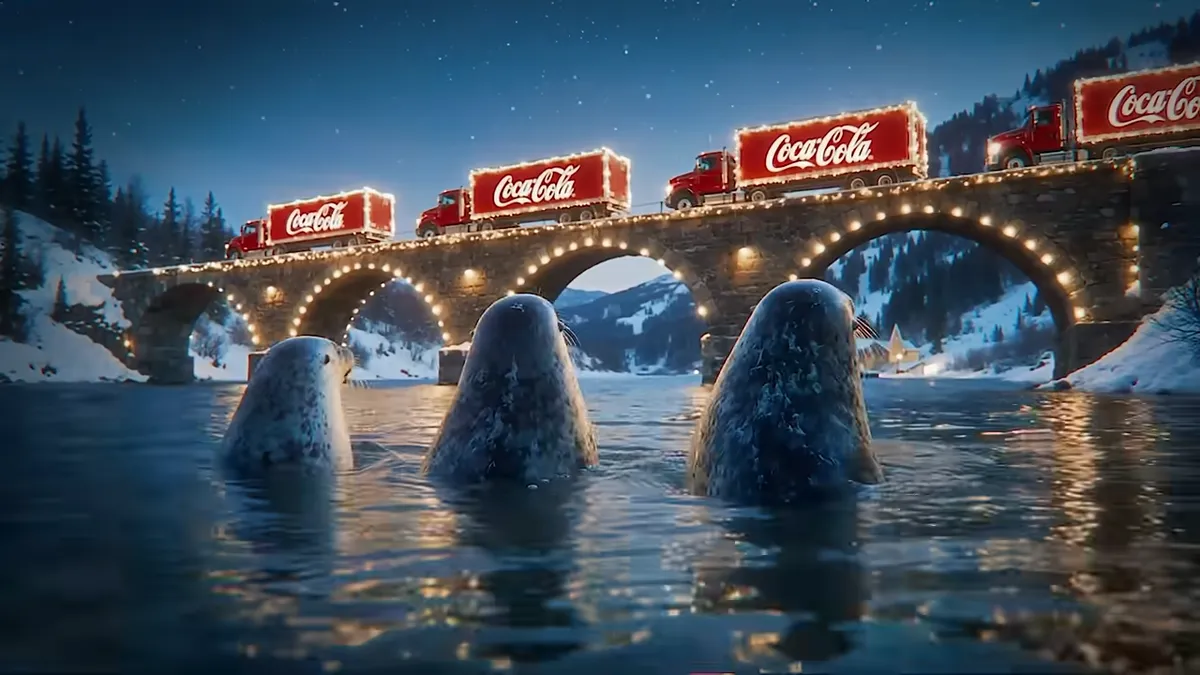
Coca Cola has once again used generative AI to remake its classic “Holidays are Coming” trucks spot. This time the 2025 campaign leant heavily on tools such as OpenAI’s Sora, Google’s Veo 3 and Luma AI, with five AI specialists refining around 70,000 clips in just 30 days.
The result is ambitious, heavily discussed, and far from flawless. Viewers quickly spotted trucks changing shape between shots, wheels that appear and disappear, and awkward moments of almost-collisions. Yet research firm System1 still gave the ad its highest possible effectiveness score of 5.9 stars, suggesting strong long term brand impact despite the visible glitches.
So why would a brand as established as Coca Cola keep pushing AI after two years of public criticism, and what should other advertisers, particularly in MENA, take away from the experiment?
Why a heritage brand chooses a risky AI route
Strategic positioning not just cost saving
On the surface, generative AI promises faster, cheaper production. An AI remake finished in 30 days with a compact team is very attractive if you are managing multiple markets and formats.
But Coca Cola’s move is about more than efficiency. The company’s senior leadership has repeatedly framed AI as “the future” and positioned Coke as a pioneer that prefers to learn in the open rather than wait for perfect tools. Taking visible risks becomes part of the brand story.
For a legacy advertiser, that has three advantages:
- Signalling innovation to investors, partners and young audiences.
- Building AI muscle early, from creative workflows to legal and brand governance.
- Owning the debate around “AI in advertising” instead of reacting to others.
Fame and conversation as core objectives
Coca Cola’s Christmas work has always aimed for cultural presence, not quiet efficiency. AI controversy guarantees coverage, commentary and social sharing.
Even negative discussion around “AI slop” or “soulless” creative still reinforces key brand assets. Viewers are talking about red trucks, polar bears and the Coca Cola wordmark at scale, which drives salience in a highly cluttered holiday season.
From a pure communications strategy lens, the ad may be imperfect but it is undeniably famous. System1 and other testing platforms show strong attention and brand recall scores, even when emotional response is slightly weaker or more polarised than industry norms.
What the campaign reveals about generative AI limits
Continuity and “feel” still matter
The most discussed issues are not minor. Trucks that morph between scenes, physics that wobble and environments that subtly shift all signal artificiality. For a brand that trades on warmth and nostalgia, that disconnect can jar.
This highlights two current AI constraints:
- Temporal consistency: many video models still struggle to keep objects stable over multiple shots.
- Emotional authenticity: AI generated humans, animals and even environments often feel slightly off, especially in slower, more sentimental storytelling.
The gap between public chatter and private response
Public reaction has again been harsh, just as it was for Coca Cola’s 2024 AI Christmas ads. Yet both years, effectiveness testing suggests audiences are more forgiving than social media suggests, particularly when the brand codes are strong and the story is easy to follow.
For advertisers, this is a valuable reminder. Industry and Twitter outrage does not automatically equal business failure. What matters is what real consumers notice, feel and remember.
Lessons for advertisers in the UAE and MENA
1. Use AI where it enhances, not replaces, craft
Coca Cola’s experiment shows AI can compress timelines and handle vast volumes of variant footage. It is well suited to:
- Pre-visualisation and storyboarding.
- Generating background plates or stylised worlds.
- Quick localisation and versioning for multiple markets.
For most brands in MENA, AI should support human creatives rather than displace them. Critical shots, hero characters and emotional close ups still benefit from live action or premium animation. The bar for quality is especially high on large formats such as Connected TV and digital out of home, where flaws are magnified.
2. Protect brand equity before you chase novelty
Coca Cola can absorb some creative risk because its core brand assets are incredibly strong. Many regional brands do not have that luxury.
Before rolling out an AI heavy hero film, ask:
- Can viewers still recognise your distinctive assets at a glance?
- Does the execution feel consistent with your existing campaigns?
- Are any artefacts likely to be seen as careless or disrespectful to the brand?
Where the answer is unclear, consider deploying AI more modestly within YouTube and digital video campaigns first, where shorter formats and A/B testing can quickly reveal what resonates.
3. Build rigorous QA into AI workflows
One of the most surprising elements of the Coca Cola debate is that basic continuity errors made it through global quality checks. That is a process of learning for everyone.
Advertisers should:
- Treat AI video like VFX heavy work, not like a simple edit.
- Formalise review steps for continuity, physics, and brand safety.
- Test rough cuts with small consumer panels before finalising a media plan.
Generative tools are powerful but also unpredictable. Operational discipline becomes a competitive advantage.
4. Test consumer attitudes in your own category
Studies show some consumers are wary of AI generated ads, particularly where human faces and emotions are central. That does not mean all AI creative will underperform, but brand, category and culture matter.
A financial services brand in the GCC will face different expectations to a youth fashion label. Before committing heavy spend, run structured tests across your programmatic video, display network and social inventory to understand where AI led assets help or hurt performance.
Should you follow Coca Cola into AI Christmas ads
Coca Cola’s 2025 holiday experiment is not a simple success or failure. It is a high visibility test case that reveals both the promise and the current weaknesses of generative video.
For most advertisers in the UAE, GCC and wider MENA region, the smart move is not to copy the format but to copy the mindset. Start experimenting now, keep humans firmly in the loop and design your AI use cases to protect brand equity while building new capabilities.
If you structure your testing well, by the time the tools catch up with the creative ambition, your team will already know how to use them.
FAQs
Why did Coca Cola use AI for its 2025 holiday ad?
Coca Cola used generative AI to accelerate production, explore new creative possibilities and position itself as a pioneer in AI powered storytelling, even at the risk of public criticism.
What went wrong with Coca Cola’s AI holiday trucks
Viewers spotted trucks changing shape, wheels appearing and disappearing and other continuity issues. These glitches highlighted current limits of generative video tools in maintaining consistent objects across shots.
Did the AI ad still work with consumers
Despite online backlash, testing by firms such as System1 showed very strong long term brand effectiveness scores, along with high attention and recall, even though emotional response was more polarised than average.
How should brands in MENA start using AI in advertising
Brands should begin with controlled experiments, using AI to support human creatives on YouTube, Connected TV and programmatic video, while enforcing strict QA and testing consumer response before scaling.
Is generative AI ready to replace traditional production
For most advertisers, no. AI is powerful for ideation, background generation and rapid versioning, but key emotional scenes and hero assets still benefit from traditional live action or high end animation, especially for premium brand campaigns.